

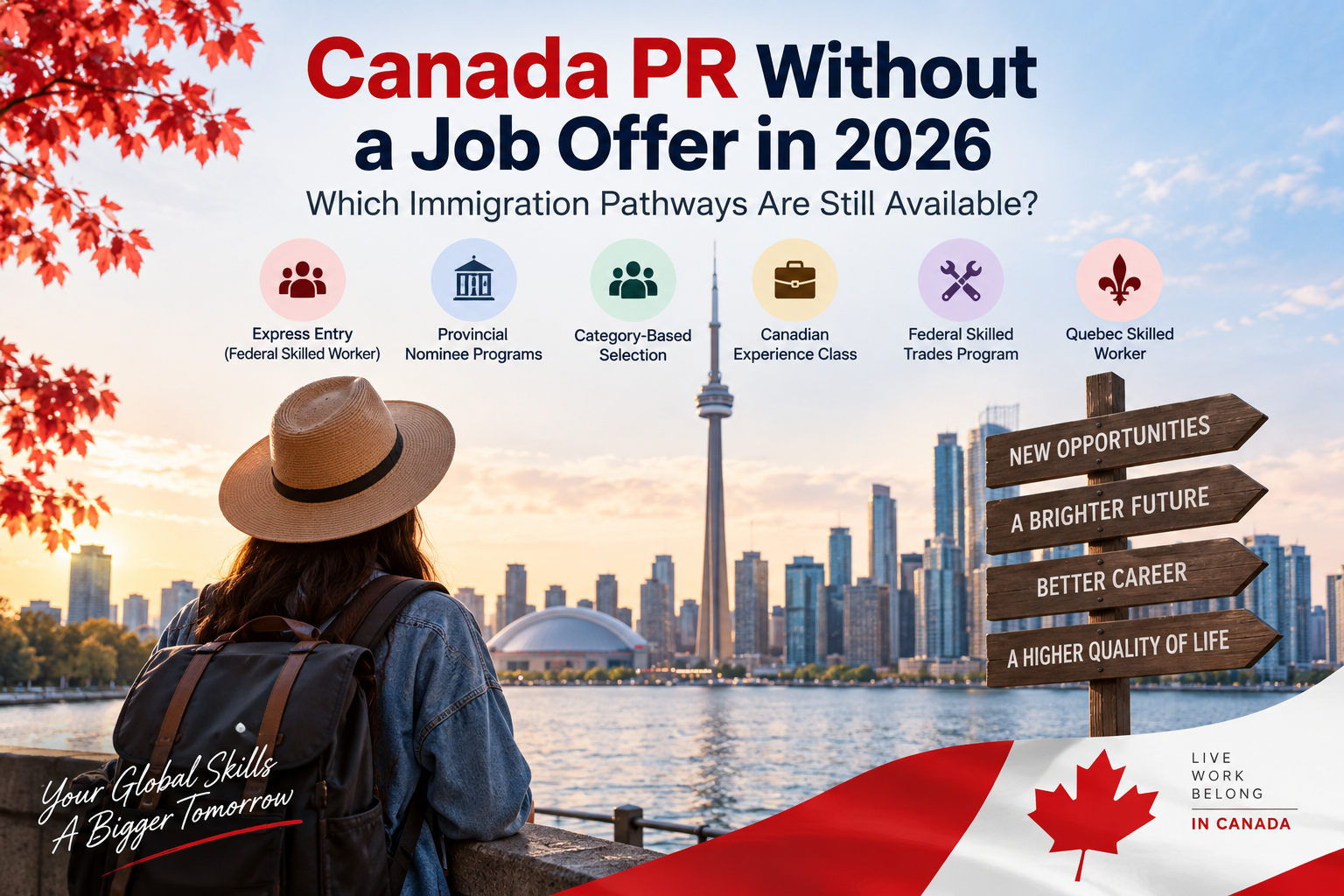
Canada continues to attract skilled professionals, experienced workers, and families looking for better career opportunities and long-term settlement. However, many potential applicants believe that securing a Canadian job offer is mandatory before applying for permanent residency.
The good news is that Canada offers several immigration pathways that do not necessarily require a job offer.
In 2026, skilled workers can still explore permanent residency through Express Entry, selected Provincial Nominee Programs, and other immigration streams based on their qualifications, professional experience, language proficiency, and eligibility.
Understanding these pathways is essential because Canadian immigration policies continue to evolve, and selecting the wrong program can lead to unnecessary delays or unsuccessful applications.
This guide explains how to apply for Canada PR without a job offer in 2026, which immigration programs are available, and what applicants should consider before starting their immigration journey.
1. Express Entry Through the Federal Skilled Worker Program
The Federal Skilled Worker Program (FSWP) remains an important immigration pathway for skilled professionals who want to move to Canada without securing employment beforehand.
This program operates under Canada’s Express Entry system and evaluates applicants based on their education, work experience, language proficiency, age, and other eligibility factors.
Unlike employer-sponsored immigration pathways, the Federal Skilled Worker Program does not require applicants to have a Canadian job offer.
Who Can Apply?
Applicants generally need to meet the following requirements:
- At least one year of continuous, paid skilled work experience in an eligible occupation within the previous 10 years.
- A minimum Canadian Language Benchmark (CLB) level of 7 in an approved English or French language test.
- A recognized educational qualification, with an Educational Credential Assessment for foreign education.
- A minimum of 67 points out of 100 under the Federal Skilled Worker selection criteria.
- Sufficient settlement funds unless an applicable exemption exists.
Once applicants meet the minimum eligibility requirements, they can create an Express Entry profile and enter the candidate pool.
However, eligibility does not guarantee permanent residency. Candidates must receive an Invitation to Apply (ITA), generally based on their Comprehensive Ranking System (CRS) score and the requirements of the invitation round.
2. Provincial Nominee Programs Without Employer Sponsorship
Provincial Nominee Programs (PNPs) allow Canadian provinces and territories to select immigration candidates who can contribute to their regional economies.
Although several PNP streams require employment offers, certain pathways may consider applicants without Canadian employer sponsorship.
Provinces assess candidates based on factors such as professional experience, education, language proficiency, occupation, and connections to the province.
Which Provincial Programs Should Applicants Explore?
Ontario’s Express Entry Human Capital Priorities Stream
Ontario can identify eligible Express Entry candidates based on their human capital characteristics and provincial selection priorities. A job offer is not mandatory for this stream.
Saskatchewan’s International Skilled Worker Pathways
Saskatchewan has historically offered pathways for skilled professionals without job offers, including occupation-based selection. Applicants must check current stream availability, eligibility, and intake restrictions.
Nova Scotia’s Express Entry-Linked Pathways
Nova Scotia operates immigration streams connected to Express Entry. Certain selection pathways may not require a job offer, although applicants must meet specific provincial requirements.
Why Is a Provincial Nomination Valuable?
Candidates who receive a qualifying nomination through an Express Entry-linked PNP can receive an additional 600 CRS points.
This can significantly improve their chances of receiving an invitation to apply for permanent residency.
However, nomination requirements vary by province, and not every PNP stream is available to overseas applicants without employment offers.
3. Express Entry Category-Based Selection in 2026
Canada’s category-based Express Entry selection system provides opportunities for candidates with specific professional backgrounds or language abilities.
Instead of selecting candidates exclusively through general CRS rankings, Immigration, Refugees and Citizenship Canada (IRCC) can conduct invitation rounds targeting designated categories.
These categories reflect Canada’s immigration priorities and workforce requirements.
Who May Benefit From Category-Based Selection?
Depending on the applicable 2026 criteria, opportunities may exist for eligible candidates in areas such as:
- Healthcare and social services
- Science, technology, engineering, and mathematics occupations
- Skilled trades
- Education occupations
- French-language proficiency
Additional categories may apply to candidates with specific Canadian work experience or professional qualifications.
Applicants must verify the current occupation lists and eligibility requirements, since category definitions and selection priorities can change.
A Canadian job offer is not universally required for category-based selection. However, candidates must qualify for an Express Entry program and meet the specific category requirements.
For skilled professionals without Canadian employment offers, this can provide another potential route to permanent residency.
4. Canadian Experience Class Without a Job Offer
The Canadian Experience Class (CEC) is another Express Entry pathway that does not require applicants to hold a current Canadian job offer.
However, this program is specifically designed for individuals who have already gained qualifying skilled work experience in Canada.
To qualify, applicants generally need at least one year of eligible Canadian skilled work experience within the previous three years.
They must also meet the required English or French language proficiency standards and demonstrate that their work experience meets the applicable immigration criteria.
For individuals who previously worked in Canada and later returned to their home country, CEC may remain an option if their Canadian experience falls within the qualifying period.
Applicants without Canadian work experience should generally explore other immigration pathways.
5. Federal Skilled Trades Program Without a Job Offer
The Federal Skilled Trades Program offers a potential permanent residency pathway for experienced tradespeople.
Although a valid Canadian job offer is one way to meet its eligibility requirements, it is not the only option.
Applicants may qualify without a job offer if they possess a certificate of qualification in their skilled trade issued by an authorized Canadian provincial, territorial, or federal authority.
The program generally requires at least two years of qualifying skilled trade experience within the previous five years.
Applicants must also meet the applicable language requirements and other immigration conditions.
This pathway may be relevant for qualified electricians, plumbers, welders, mechanics, and other eligible skilled tradespeople who can obtain Canadian trade certification.
6. Quebec Skilled Worker Immigration
Quebec manages its own skilled worker selection system, separate from federal Express Entry.
Applicants interested in settling permanently in Quebec can explore the province’s skilled worker selection program.
Quebec considers factors such as education, professional experience, occupation, French-language ability, and other selection requirements.
Certain applicants may qualify without a Canadian job offer, depending on the program’s current selection criteria.
However, Quebec’s immigration requirements differ from those of other Canadian provinces. French-language proficiency is particularly important for many skilled worker applicants.
Candidates selected by Quebec must also satisfy federal permanent residence and admissibility requirements.
What Changed for Canada PR Without a Job Offer in 2026?
One important change affecting Express Entry candidates is the removal of additional CRS points for arranged employment.
Since March 25, 2025, Canada has no longer awarded the previous 50 or 200 additional CRS points for qualifying job offers.
This means candidates without Canadian employment offers are no longer competing against those additional job-offer points under the CRS.
However, valid job offers can still affect eligibility under certain immigration programs and the Federal Skilled Worker selection grid.
In 2026, Canada has also continued using category-based selection to prioritize specific professional backgrounds and French-language proficiency.
The renewed occupational categories generally require at least one year of eligible experience within the previous three years, rather than the earlier six-month requirement.
These changes make it important for applicants to evaluate their eligibility against current selection criteria rather than relying on outdated immigration information.
How to Improve Your Chances of Getting Canada PR Without a Job Offer
A Canadian job offer is not the only factor that influences immigration eligibility or selection.
Applicants can strengthen their profiles through several practical steps.
Improve Your Language Test Results
Higher English or French language scores can increase your CRS points and improve your competitive position within the Express Entry pool.
Complete Your Educational Credential Assessment
Applicants with foreign educational qualifications may need an Educational Credential Assessment to establish how their credentials compare with Canadian standards.
Explore Provincial Nomination Opportunities
Provincial nominations can provide additional opportunities for applicants whose occupations and qualifications match provincial priorities.
Consider French-Language Proficiency
Eligible French-speaking candidates may benefit from dedicated Express Entry invitation rounds and additional CRS points for French proficiency.
Prepare Your Financial Documents
Applicants under the Federal Skilled Worker Program generally need to demonstrate sufficient settlement funds unless they qualify for an exemption.
The required amount depends on family size and is updated periodically.
Choose the Correct Immigration Program
Applicants should evaluate their work experience, education, language proficiency, age, and settlement intentions before selecting a pathway.
A program that suits one candidate may not be appropriate for another.
Frequently Asked Questions About Canada PR Without a Job Offer
Can I apply for Canada PR from Pakistan, India, or the UAE without a job offer?
Yes. Eligible applicants residing in Pakistan, India, the UAE, and other countries can apply through immigration programs that do not require Canadian employer sponsorship.
Is Canada PR possible without Canadian work experience?
Yes. The Federal Skilled Worker Program accepts eligible foreign work experience, allowing qualifying professionals to apply without previously working in Canada.
What is the minimum CRS score required for Canada PR in 2026?
There is no fixed CRS score that guarantees permanent residency. Invitation thresholds vary depending on the type of Express Entry draw and the candidates selected.
Can I apply for Canada PR after the age of 35?
Yes. Applicants over 35 can still qualify for Canadian permanent residency. However, age affects the number of points awarded under certain immigration selection systems.
Is IELTS compulsory for Canada PR?
Applicants generally need results from an approved English or French language test for Express Entry. IELTS General Training is one accepted option, alongside other approved tests.
How much money is required for Canada PR without a job offer?
The financial requirement depends on your family size and immigration program. Federal Skilled Worker applicants generally need proof of settlement funds unless an exemption applies.
Does applying without a job offer reduce my chances of approval?
Not necessarily. Several immigration programs are designed to accept applicants without Canadian employment offers. Selection depends on program eligibility, ranking, documentation, and applicable immigration requirements.
Final Thoughts: Is Canada PR Without a Job Offer Still Possible in 2026?
Canada PR without a job offer remains possible in 2026 for eligible skilled professionals, experienced workers, and other qualifying applicants.
Programs such as the Federal Skilled Worker Program, selected Provincial Nominee Programs, Canadian Experience Class, and certain skilled trade and Quebec immigration pathways provide different opportunities depending on an applicant’s circumstances.
However, qualifying for an immigration program and receiving an invitation to apply are two different stages.
Applicants should carefully evaluate their professional experience, language proficiency, educational qualifications, financial readiness, and immigration goals before beginning the process.
Get Professional Assistance With Your Canada PR Application
Planning to immigrate to Canada but don’t have a Canadian job offer?
Our immigration consultants can help you understand your eligibility, explore suitable immigration pathways, and prepare for the Canadian permanent residency application process.
Whether you are a skilled professional, experienced worker, or planning to relocate with your family, choosing the right immigration pathway is an important first step.
Contact our immigration consultancy today to schedule your Canada PR eligibility assessment and explore your available options.